Cooking is an important life skill that allows people to prepare fresh, tasty, and satisfying meals at home. However, learning how to cook can feel challenging, especially when someone has little experience in the kitchen. Beginners often make simple mistakes that affect the taste, texture, appearance, and quality of their food.
The good news is that most cooking mistakes are easy to understand and prevent. Learning basic cooking techniques, understanding ingredients, and developing good kitchen habits can make a noticeable difference in everyday meals.
Cooking is not only about following recipes. It also involves patience, preparation, temperature control, and knowing how different ingredients behave during the cooking process.
This article explains the most common cooking mistakes beginners should avoid and provides practical tips to help new home cooks improve their confidence and cooking skills.
1. Starting Cooking Without Reading the Recipe
One of the most common cooking mistakes beginners make is starting a recipe without reading all the instructions.
Many people read only the first few steps and begin cooking immediately. Later, they discover that an ingredient needs preparation or that the recipe requires additional cooking time.
This can create confusion and lead to mistakes.
Before starting any recipe, read the complete instructions carefully. Check the ingredients, measurements, cooking methods, and estimated preparation time.
For example, if a recipe requires marinated chicken, prepare the marinade before heating the cooking pan.
Understanding the recipe in advance helps beginners organize their work and avoid unnecessary interruptions.
2. Not Preparing Ingredients Before Cooking
Preparing ingredients before starting the stove is an important habit that many beginners overlook.
Some people begin heating oil while their vegetables are still unwashed or their spices remain unmeasured.
This creates pressure because ingredients may burn while the cook is busy preparing something else.
A better approach is to wash vegetables, chop ingredients, measure spices, and arrange cooking tools before beginning.
Professional kitchens often follow a preparation method called mise en place, which means keeping everything ready and in its proper place.
This simple habit saves time, reduces stress, and makes the cooking process more organized.
It is especially useful when preparing dishes that cook quickly.
3. Using the Wrong Cooking Temperature
Temperature control is one of the most important basic cooking skills for beginners.
Cooking food at excessively high temperatures can burn the outside while leaving the inside undercooked.
On the other hand, using very low heat may prevent certain foods from developing the desired texture and flavor.
Different ingredients require different cooking temperatures.
For example, vegetables often benefit from moderate or high heat when sautéing, while soups and stews generally need gentle simmering.
Beginners should learn the difference between low, medium, and high heat.
Adjusting the stove temperature according to the recipe helps produce better cooking results.
Remember that high heat does not always mean faster or better cooking.
4. Adding Too Much Oil
Many beginners believe that using more cooking oil will make food tastier.
However, excessive oil can make meals greasy and affect their natural flavor.
Different cooking methods require different amounts of oil.
For example, lightly sautéing vegetables usually requires less oil than deep frying.
Using a measuring spoon can help beginners control the amount of oil they add.
Nonstick cookware, when used according to its manufacturer’s instructions, may also help reduce the oil needed for certain recipes.
A balanced amount of oil allows ingredients, herbs, and spices to contribute their natural flavors.
5. Using Too Much or Too Little Salt
Salt is an important seasoning, but incorrect amounts can easily affect the taste of food.
Adding too much salt can make a dish unpleasant, while using too little may leave it tasting bland.
Beginners sometimes add large amounts of salt at the beginning without considering how the flavor will change during cooking.
For example, soups and sauces may become saltier as water evaporates.
A useful cooking habit is to add salt gradually and taste the food when it is safe to do so.
Remember that packaged sauces, cheese, and certain seasonings may already contain significant amounts of sodium.
Learning how to balance salt with other ingredients is an important part of improving cooking skills.
6. Overcrowding the Cooking Pan
Placing too many ingredients into a small cooking pan is another common mistake.
When a pan becomes overcrowded, moisture released by ingredients may collect instead of evaporating quickly.
As a result, food that should become golden and slightly crisp may turn soft or watery.
This commonly happens when cooking mushrooms, chicken pieces, or vegetables.
To avoid overcrowding, use a sufficiently large pan or cook ingredients in smaller batches.
Leaving some space between ingredients allows heat to circulate more effectively and encourages browning.
Although cooking in batches takes additional time, it can improve the texture and overall quality of the finished meal.
7. Stirring Food Too Frequently
Beginners often feel that they must continuously stir food to prevent burning.
However, excessive stirring can interfere with certain cooking methods.
For example, when cooking chicken pieces or sautéing vegetables, leaving the ingredients undisturbed briefly can help develop a golden surface.
Constant movement may prevent proper browning.
At the same time, some dishes, including certain sauces and puddings, require frequent stirring to prevent sticking.
The key is understanding the cooking method.
Instead of stirring automatically, observe the food and follow the recipe’s instructions.
Learning when to stir and when to leave ingredients undisturbed can improve both flavor and appearance.
8. Not Preheating the Pan or Oven
Preheating is an essential cooking step that beginners sometimes skip.
Placing ingredients into a pan before it reaches the appropriate temperature may affect how evenly they cook.
Similarly, putting baked food into a cold oven when the recipe requires preheating can change its texture and cooking time.
For example, cakes, cookies, and bread often depend on a properly heated oven for consistent results.
Before cooking, allow the pan or oven to reach the recommended temperature.
However, avoid overheating empty cookware, particularly nonstick pans.
Following the manufacturer’s guidance and the recipe instructions helps maintain both cooking quality and kitchen safety.
9. Cutting Vegetables Into Uneven Pieces
The size of chopped ingredients affects how quickly and evenly they cook.
When vegetables are cut into very different sizes, smaller pieces may become soft before larger pieces are ready.
For example, small potato cubes usually cook faster than large potato chunks.
Beginners should try to cut ingredients into reasonably similar sizes when the recipe requires even cooking.
Using a sharp knife and a stable cutting board makes preparation easier.
Knife skills improve through regular practice.
There is no need to achieve perfect shapes. The main goal is to prepare pieces that cook at approximately the same rate.
10. Cooking Meat Without Checking Its Internal Temperature
One of the most important cooking mistakes to avoid involves judging whether meat is cooked only by its color or appearance.
Food may look fully cooked on the outside while remaining unsafe inside.
A food thermometer provides a more reliable way to check doneness.
For example, poultry should reach an internal temperature of 74°C or 165°F. Ground meat such as beef generally requires 71°C or 160°F, while whole cuts of beef require at least 63°C or 145°F followed by a three minute rest.
Different foods have different recommended temperatures.
Beginners should check reliable food safety guidance and measure the temperature in the thickest part of the food.
This simple habit helps improve food safety and reduces guesswork.

11. Adding All Spices at the Wrong Time
Spices contribute aroma, color, and flavor to many homemade dishes.
However, adding them at the wrong stage can affect the final result.
Some spices release their aroma when briefly heated in oil, while delicate fresh herbs often retain more of their flavor when added near the end of cooking.
For example, cumin seeds may be heated briefly in oil, while fresh coriander leaves are commonly added during the final cooking stage.
Beginners should also avoid overheating ground spices because they can burn and develop a bitter taste.
Understanding how and when to use spices helps create more balanced flavors.
12. Following Cooking Times Without Checking the Food
Recipes provide useful cooking times, but those times are usually estimates.
Actual cooking time depends on several factors, including ingredient size, stove performance, cookware, and starting temperature.
Beginners sometimes follow a recipe’s timing exactly without checking whether the food is properly cooked.
For example, vegetables may become tender earlier than expected, while large potato pieces may require additional cooking time.
Use the recommended time as a guide rather than an absolute rule.
Check the texture, appearance, and appropriate internal temperature before deciding that a dish is ready.
Developing observation skills is an important part of becoming a confident home cook.
13. Using the Wrong Cooking Tools
Cooking becomes more difficult when unsuitable tools are used.
For example, a small pan may not provide enough space for sautéing vegetables, while a thin cooking pot may heat unevenly and cause certain foods to stick.
Beginners do not need expensive kitchen equipment.
A few reliable tools are usually enough for everyday meals.
These include a sharp knife, a cutting board, measuring spoons, a saucepan, a frying pan, and a sturdy cooking spoon.
A food thermometer is also valuable for preparing meat safely.
Choosing tools according to the cooking task makes preparation easier and improves consistency.
14. Ignoring Basic Food Safety Rules
Food safety is just as important as flavor.
Beginners sometimes make mistakes such as leaving perishable ingredients at room temperature for too long or using the same cutting board for raw meat and ready to eat vegetables.
These habits increase the risk of foodborne illness.
Wash your hands with soap and water before preparing food and after handling raw meat.
Keep raw meat separate from foods that will be eaten without further cooking.
Clean utensils, cutting boards, and countertops after contact with raw ingredients.
Refrigerate perishable foods promptly, generally within two hours, or within one hour when temperatures exceed 32°C.
Good hygiene makes home cooking safer for everyone.
15. Trying Complicated Recipes Too Early
Beginners sometimes choose difficult recipes because the finished dishes look attractive.
However, complex recipes often require several cooking techniques, precise timing, and experience.
Attempting too many unfamiliar techniques at once can make cooking stressful.
A better approach is to start with simple meals.
Boiled rice, omelets, vegetable soup, basic pasta, and grilled or pan cooked vegetables are useful options for practicing fundamental skills.
Once these dishes become familiar, beginners can gradually explore more challenging recipes.
Learning one technique at a time helps build confidence and encourages steady improvement.
16. Not Tasting Food During Cooking
Tasting food is one of the simplest ways to understand how flavors develop.
Many beginners wait until the meal is completely finished before checking its taste.
By then, correcting certain seasoning problems may become difficult.
For dishes that are safe to taste during cooking, use a clean spoon to check the flavor occasionally.
Notice whether the food needs additional seasoning, acidity, or cooking time.
A little lemon juice may brighten some dishes, while herbs can improve their aroma.
Never taste raw meat, raw batter containing unsafe ingredients, or other foods that require cooking for safety.
Regular tasting, when safe, helps beginners develop a better understanding of flavor balance.
17. Not Allowing Cooked Meat to Rest
Cutting meat immediately after removing it from the heat is a common beginner mistake.
Allowing cooked meat to rest briefly can help retain moisture when it is sliced.
The appropriate resting time depends on the type and size of the meat.
For example, whole cuts of beef have a recommended three minute rest as part of safe cooking guidance.
During resting, the internal temperature may continue to rise slightly.
Beginners should follow reliable temperature and resting recommendations rather than relying only on appearance.
This helps produce meat that is both properly cooked and enjoyable to eat.
18. Giving Up After One Cooking Failure
Not every recipe turns out perfectly on the first attempt.
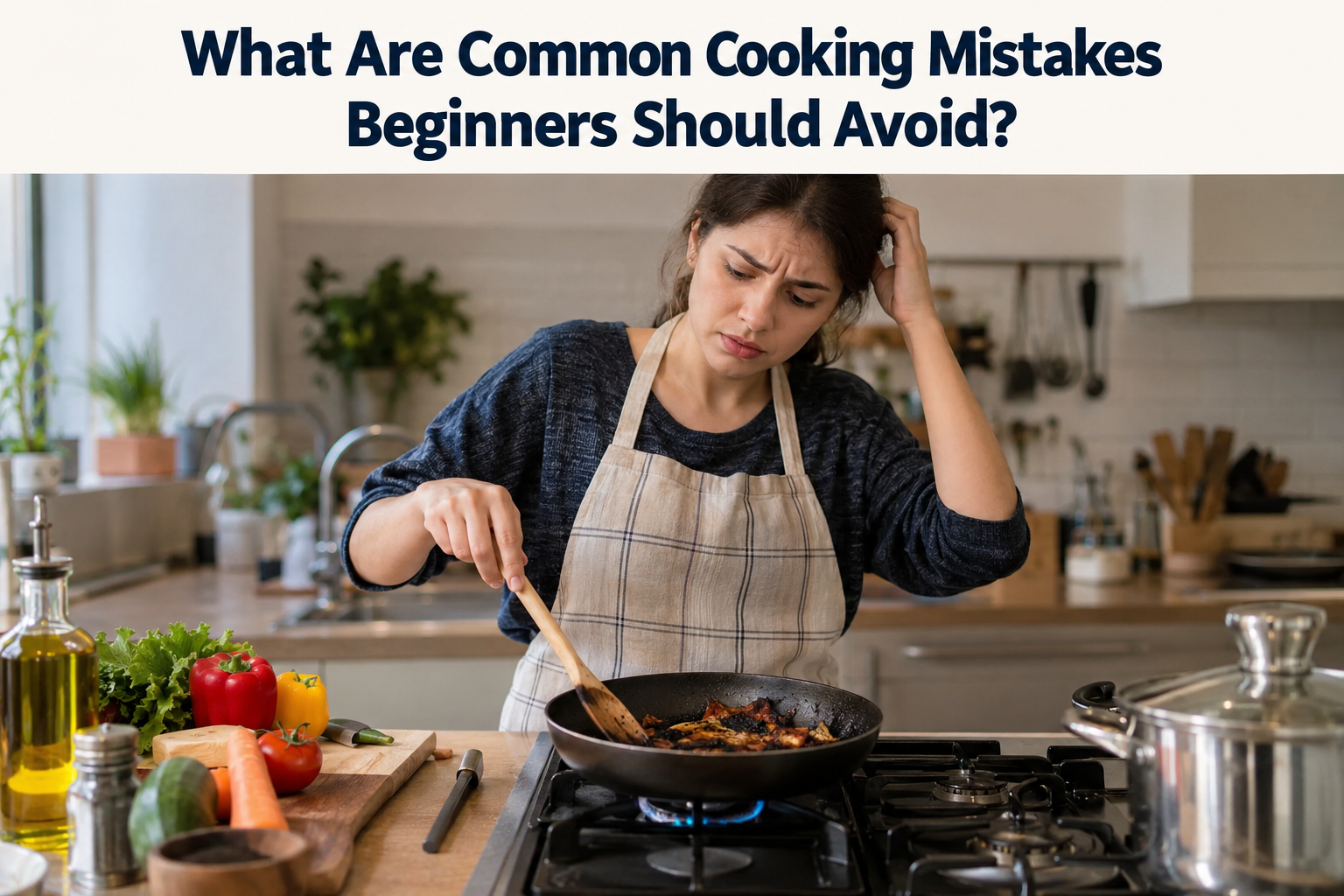
Beginners may burn vegetables, overcook rice, or add too much seasoning.
These experiences are a normal part of learning.
Instead of becoming discouraged, try to identify what caused the problem.
Perhaps the heat was too high, the cooking time was too long, or the ingredients were measured incorrectly.
Making small adjustments during the next attempt can lead to better results.
Keeping simple notes about successful recipes and cooking mistakes can also be helpful.
With regular practice, cooking becomes more familiar, enjoyable, and manageable.
How Can Beginners Improve Their Cooking Skills?
Improving cooking skills does not require preparing difficult meals every day.
Consistency and attention to basic techniques are more important.
Begin by selecting a few simple recipes and preparing them regularly. Focus on learning how to control heat, measure ingredients, prepare vegetables, and recognize when food is properly cooked.
Reading reliable cookbooks and food safety resources can improve your understanding of different cooking methods.
Watching experienced home cooks can also help beginners observe techniques that may be difficult to understand from written instructions alone.
Most importantly, avoid rushing through the cooking process.
Good preparation, patience, and regular practice help beginners develop confidence and achieve more consistent results.
Frequently Asked Questions
What is the biggest mistake beginners make when cooking?
One of the biggest mistakes is starting to cook without preparing ingredients or understanding the recipe. Reading instructions and organizing ingredients beforehand can prevent many common problems.
How can beginners avoid burning food?
Use the recommended cooking temperature, choose suitable cookware, and monitor the food regularly. Avoid using high heat for every recipe.
Why does homemade food sometimes taste bland?
Food may taste bland because of insufficient seasoning, poor ingredient balance, or incorrect cooking methods. Proper use of salt, herbs, spices, and acidic ingredients can improve flavor.
Should beginners always follow recipes exactly?
Beginners should follow recipes closely while learning, particularly for baking and food safety requirements. As their experience improves, they can make suitable adjustments to seasoning and ingredients.
How long does it take to become good at cooking?
There is no fixed timeline. Improvement depends on practice, patience, and the variety of cooking techniques learned. Preparing simple meals regularly can gradually improve confidence and ability.
Conclusion
Understanding common cooking mistakes beginners should avoid is an important step toward becoming a better home cook.
Simple problems such as using the wrong temperature, adding excessive oil, overcrowding pans, skipping preparation, and ignoring food safety can affect the quality of homemade meals.
Fortunately, these mistakes can often be prevented by developing better kitchen habits and learning basic cooking techniques.
Reading recipes carefully, preparing ingredients in advance, using suitable tools, and checking food during cooking can make everyday meal preparation easier.
Cooking is a skill that improves through experience. Every meal provides an opportunity to learn something useful.
By staying patient, practicing regularly, and paying attention to small details, beginners can gradually prepare delicious, safe, and satisfying meals with greater confidence.